No Destination Required: Learning to Walk Off the Clock Like the Italians
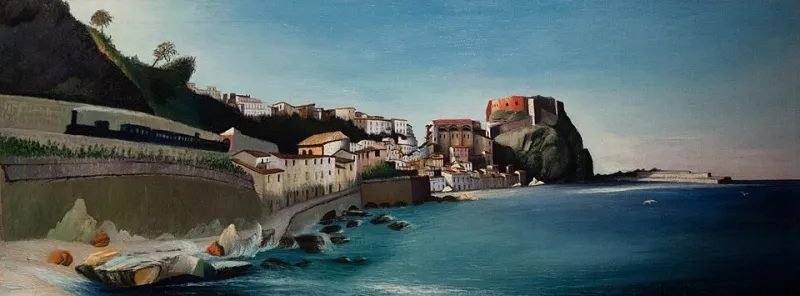
Photo: Tivadar Csontváry Kosztka, Public domain, via Wikimedia Commons
There's a moment, around 7 p.m. in any town along the Ligurian coast, when something odd happens by American standards: nothing. Restaurants aren't open yet. Nobody's checking email. The whole town, it seems, has spilled into the street for the sole purpose of being in it.
This is the passeggiata — the evening stroll — and if you've never experienced it, it can feel almost transgressive. Grown adults, dressed nicely, walking in loose circles along the seafront with a gelato in hand, stopping every fifty feet to talk to someone they already talked to yesterday. No destination. No step goal. No podcast queued up.
As someone who moved to this bay from a life of calendar blocks and optimization, I'll say it plainly: Americans don't know how to have an evening. We know how to recover from the day, or prep for tomorrow. The passeggiata is a third option we've mostly forgotten.
It's Not a Walk. That's the Whole Point.
The first mistake is treating the passeggiata like exercise or productivity in disguise. If you're tracking your pace, you're doing it wrong. If you've turned around because you hit your distance, you've missed it entirely.
The passeggiata is social infrastructure. It's where news travels, where teenage romances get their start under the watchful eyes of grandmothers, where the fisherman and the pharmacist argue about politics. In small coastal towns, it's the evening's actual event — everything else (dinner, TV, sleep) orbits around it.
There's also a quiet performance to it. You dress for the passeggiata. Not formal, but considered. The stroll is a low-stakes way of saying: I'm here, I'm part of this, I have nowhere else to be.
What It's Doing for You (Even If It Looks Like Nothing)
Here's the part my fellow productivity addicts will appreciate: the passeggiata works. Not despite its aimlessness — because of it.
Sociologists have long noted that unstructured, repeated public rituals build social trust in ways nothing else quite does. Seeing the same faces nightly, without obligation, creates what researchers call "weak ties" — the casual acquaintances who, studies suggest, contribute more to day-to-day happiness than we realize.
Then there's the physiological side. A gentle post-dinner walk aids digestion, drops cortisol, and signals to your body that the day is closing. It's a boundary ritual — a hard edge between work and rest that doesn't involve a screen. Americans tend to end the day by collapsing into the couch with a phone. The Italians end it by moving slowly through the world with other people in it.
Stealing the Habit, State-Side
You don't need a Ligurian seafront. You need a loop, a loose time, and ideally a companion or three.
Pick a circuit. The passeggiata works best as a loop through a defined space — a neighborhood, a park, a main street. The repetition matters. You want to become a familiar face on that route.
Fix a rough window. Traditionally it runs from about the end of the workday until dinner. Try 6 to 7:30 p.m. The consistency is what turns it into ritual rather than a one-off walk.
Ditch the earbuds. At least sometimes. The soundtrack is conversation, church bells, other people's dogs. If the silence makes you twitchy, that's the twitchiness of withdrawal, and it passes.
Add a small prop. In Liguria it's gelato or an aperitivo. At home it might be a coffee, a popsicle, a seltzer from the corner store. The point is a small pleasure that marks this as leisure, not transit.
Invite the neighbors. Or don't — but say yes when you run into them. The passeggiata runs on spontaneous conversation, the kind that never happens if you're crossing the parking lot with your head down.
Where to Learn From the Source
If you want the authentic version, come see us on the coast. The seafront promenade through our bay, from the breakwater to the old town, is a textbook run — couples, strollers, men in pressed shirts debating football, teenagers orbiting teenagers.
For the grand version, walk the passeggiata in Nervi, east of Genoa: two kilometers along cliffs above the sea, framed by roses and palms, with the whole city out in force on summer evenings. Monterosso's seafront does a beautiful small-town rendition, best followed with a scoop of lemon granita. And in Camogli, the stroll ends at the water's edge with fried anchovies in a paper cone — which, honestly, might be the highest form the tradition achieves.
The habit, though, doesn't require a plane ticket. It requires a decision: that the evening belongs to you, and that doing nothing — slowly, in company, in nice shoes — is a legitimate way to spend it. The Italians figured that out centuries ago. We're just late to the walk.