Five Dishes Ligurian Grandmothers Make When Nobody's Looking
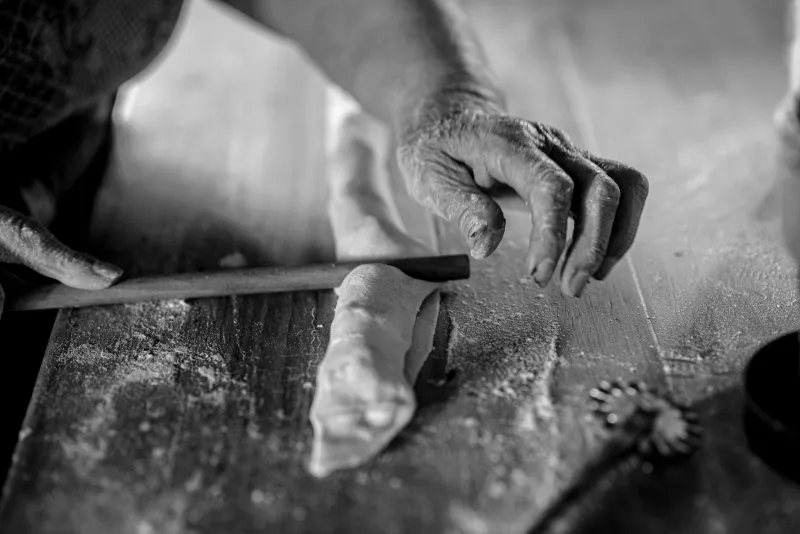
Every tourist menu on the Ligurian coast offers the same respectable canon: pesto, focaccia, trofie al pesto, maybe a farinata if the owner is feeling proud. All of it good. None of it the whole story.
The rest of the story lives in kitchen drawers. Handwritten cards, grease-spotted, in handwriting that slopes downhill. These are the dishes Ligurian grandmothers make for family, for Tuesday, for no occasion at all—and the reason they never appear on a tourist menu is the whole point of this article.
1. Farinata di Avanzi: The Leftover Chickpea Pancake
Farinata—that flat, crackly-edged chickpea pancake—is famous enough to have its own tourist reputation. What doesn't travel is farinata di avanzi: yesterday's farinata, diced and refried in olive oil until the edges crisp into something between a crouton and a hash brown.
It's breakfast, technically. It's also the clearest statement of Ligurian kitchen philosophy you'll ever eat: nothing good gets thrown away, and yesterday's food, treated with respect, becomes today's better food. No restaurant can serve it because no restaurant has yesterday's farinata sitting around at 7 a.m. Only a home does.
2. Pasta alle Noci: The Pesto's Poor Cousin
When walnuts were in season and basil wasn't, the grandmothers of the coast made pesto's humbler relative: a sauce of walnuts, garlic, a soaking of stale bread, a little milk, and parmesan, pounded together and tossed with whatever pasta was in the tin.
It never got famous because it was never trying to be. It's richer and quieter than pesto—no bright green, no perfume, just a creamy, nutty warmth that tastes like a pantry solving its own problems. Ask for it in a restaurant and you might find it on a modern menu for €16. Ask a nonna and she'll tell you it's what you make when the garden gives you walnuts and the week gives you nothing else. The restaurant version is fine. The drawer version is honest.
3. Pan Burido: Bread Soup for Bread That Gave Up
In Ligurian kitchens, stale bread was never trash—it was an ingredient waiting for a job. Pan burido (the name roughly means 'drunk bread') takes dried-out loaves, soaks them in broth or water, then revives them with olive oil, garlic, and whatever cheese rind was in the fridge, cooked until the whole pot turns into a thick, spoon-coating porridge.
This is peasant food in the most dignified sense: a dish invented by scarcity that turns out to be genuinely delicious. You will not find it on a menu because it requires stale bread, and restaurants don't have stale bread—they have inventory. Homes have leftovers. The dish belongs to homes.
4. Torta di Riso: The Rice Cake That Fixes Dinner
Leftover risotto or plain boiled rice, a couple of eggs, cheese, maybe some zucchini or a handful of herbs—pressed into a pan and baked until it holds together in slices. Cold the next day, it's arguably better, packed in the same way American grandmothers packed meatloaf sandwiches.
The torta di riso is the Ligurian answer to the question every household asks at 6 p.m.: what do I do with this? It's not a recipe so much as a formula, and every nonna's formula is different and every nonna believes hers is the only correct one. That argument, incidentally, is half the pleasure of being invited to lunch.
5. Friscieu: The Fritters That Use Up Whatever's Left
Friscieu are thin fritters—batter of flour, egg, milk, sometimes chopped herbs or leftover vegetables or even tiny anchovies—fried in olive oil and eaten hot, standing up, straight from the paper towel.
They're what happens when the vegetables are wilting and someone decides that's a problem frying can solve. Sweet versions appear with a dusting of sugar; savory ones disappear before they reach the table. Like everything on this list, they're defined by improvisation, which is exactly why no restaurant can standardize them. A kitchen that measures can't make friscieu. A kitchen that's paying attention can.
Why You'll Never See Them on a Menu
Notice the pattern. Every one of these dishes requires leftovers, stale bread, seasonal improvisation, or a grandmother's specific hand. Restaurants need consistency, cost control, and dishes that photograph well. Home cooking needs only to feed the people at the table tonight.
That's why the drawer is the right archive for these recipes. They were never products. They were solutions—and the love was in the solving.
If you're lucky enough to be invited into a Ligurian kitchen, don't ask what the dish is called. Ask what it was made from. The answer is always the same: whatever there was. And somehow, whatever there was turns out to be exactly enough.