The Bells Keep a Different Kind of Time: What Happens When You Stop Knowing What Day It Is
Somewhere around day nineteen, I stopped knowing what day it was.
Not in the panicky, vacation's-over-soon way. In the genuinely, embarrassingly neutral way—like forgetting the name of a celebrity you never cared about. It was a Tuesday, I later confirmed. It had also, functionally, been a Tuesday the day before, and would be a Tuesday for several days after. The calendar had simply stopped being load-bearing.
If you've only ever lived by the American week, this sounds like chaos. I promise you it isn't. It's just a different clock.
The Week Is a Corporate Product
Here's the thing nobody says out loud: the Monday-to-Friday structure isn't natural law. It's a scheduling agreement between employers, and it leaks into everything—when we grocery shop, when we socialize, when we're allowed to feel tired. The weekend becomes a pressure valve, and Sunday night becomes a low-grade grief known in every American household as the Sunday Scaries.
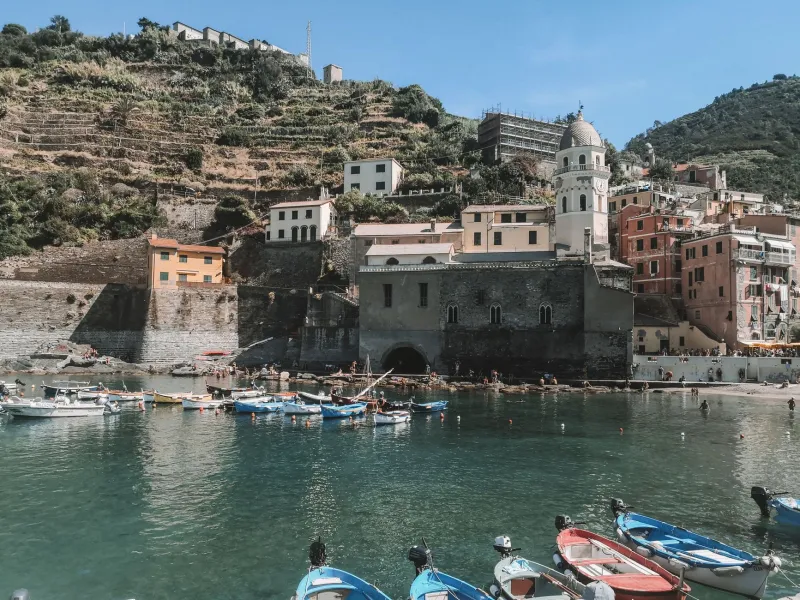
Ligurian towns run on a different operating system entirely. Time here is structured around bells, market days, and feast days. The church bell doesn't ring on a weekly grid; it rings on a daily one—marking the hours, calling people to things, occasionally just clearing its throat at noon. Market day might be Thursday. The town's patron saint might claim a Tuesday in June, and suddenly Tuesday is the biggest day of the month, and the idea of 'hump day' collapses into absurdity.
The result is that days don't stack into a staircase with a weekend at the top. They're more like beads on a string—each one similar in weight, differentiated by what happens on it, not by its position in a hierarchy.
What It Does to Your Nervous System
I want to be honest about the withdrawal period, because nobody warns you.
For the first week or so, I kept reaching for the day of the week like a phantom limb. I'd wake up and mentally check: is it Saturday? Do I get something? Am I in trouble? That little internal auditor, the one every American carries, kept clocking in for a shift that no longer existed.
Then it quieted down. And what replaced it was startling: a flat, even contentment. Without the weekend as a reward to chase, there was nothing to defer. If I wanted to have a long lunch on a Wednesday, the Wednesday had no opinion about it. Nobody was saving their joy for Saturday, because Saturday wasn't a higher form of day. The feast of some saint I'd never heard of could land on a random Thursday and produce more genuine festivity than an American holiday weekend, precisely because nobody had spent three days dreading the recovery.
Psychologists call the American version 'temporal scarcity'—the feeling that free time is a limited resource you're always about to run out of. The bay runs on temporal abundance, or at least temporal indifference. Time isn't scarce. It's just there, ringing out over the harbor every hour whether you count it or not.
How to Smuggle This Home
You can't quit your job and move to a fishing village. Fine. But a month of bell-shaped time taught me a few things that survived the flight home to the States.
Stop asking 'what day is it' and start asking 'what's happening today.' The Ligurian question is about content, not position. Is today the market? Is there something at the church? Is the fish good? Answering that question gives a day texture without giving it rank.
Create one weekly anchor that isn't the weekend. My Ligurian landlady had market day; I now have a standing Wednesday walk with a friend. It's not a reward, it's a rhythm. Rhythms don't produce Sunday Scaries.
Dismantle the Sunday night ritual of dread. The Scaries are a habit, not a law of nature. I started scheduling something genuinely pleasant for Monday morning—good coffee, a real breakfast, ten minutes outside before the phone. Monday stopped being a wall and became, well, a bead on a string.
Let the hours, not the days, structure your attention. The bell rings at noon and people eat. It rings in the evening and people walk. That's the whole system. Eat at actual meal times. Walk in the evening. It sounds insultingly simple, and it works about as well as anything I've ever tried.
The Bells Don't Care, and That's the Gift
The church bell in the bay doesn't know your deadlines, your quarterly goals, or your fantasy football draft. It rings because it's noon, and that's all it has ever needed to know.
There's a version of you that could use a calendar with fewer opinions. Not empty—just less hierarchical. A week where no day is the villain and no day is the prize.
I still don't always know what day it is. Increasingly, I consider that a skill.