The Balcony Does the Drying: What Ligurian Laundry Lines Know About Time
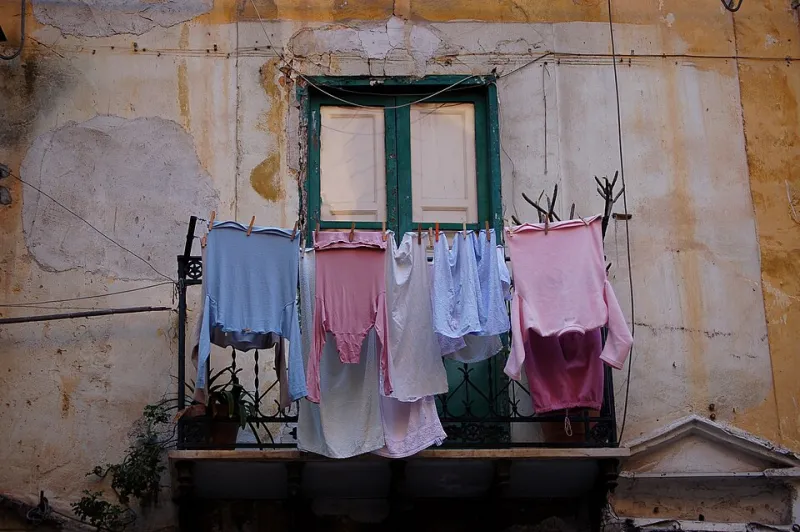
Photo: Rino Porrovecchio from Palermo, Italy, CC BY-SA 2.0, via Wikimedia Commons
Laundry in Liguria is not hidden. It hangs over the alley like a string of small flags. A row of socks, a towel, a nightgown, a child's T-shirt. In the morning, the lines fill. By late afternoon, they are empty again. If you walk through a Ligurian village at the right hour, you can read the day from the balconies. Sheets mean someone has time. A line of dark work shirts means someone left early. A single towel on a tiny balcony means someone lives alone and does not pretend otherwise.
The daily flag of the alley
In the United States, laundry is often a private transaction between a machine and a closet. The dryer hums. The vent exhales. The door stays shut. In Liguria, the balcony is a tool, and the line is part of the architecture. The wash is not an embarrassment to be hidden from neighbors. It is simply what the day looks like.
This is not because Ligurians are exhibitionists. It is because the sun is free, the air moves, and a dryer is an expensive machine that takes up space. In a narrow coastal town, space is the thing you do not have. The balcony is already there. The line is already there. The wind comes off the water. Why would you fight it?
Sun as a utility, not a backdrop
For a visitor, the Ligurian sun is scenery. For a resident, it is a utility. You learn which balconies get morning sun and which get the afternoon blast. You learn which alleys catch a breeze and which turn into a pocket of still, warm air. You learn to hang the heavy things first, to shake out the sheets, to bring the wash in before the evening damp settles. This is not rustic nostalgia. It is practical knowledge, passed down through small corrections: not there, here; not yet, later.
There is a rhythm to it. The wash goes out after breakfast. It comes in before dinner. In between, the day happens around it. Someone leans out to check the sky. Someone flips a towel. Someone shouts across the alley about the weather, or the football, or whether the fish guy came by. The laundry line is a schedule and a conversation starter at the same time.
The American dryer and the locked yard
In the US, we have built entire neighborhoods around the idea that private life should be invisible. The dryer is in a closet or a basement. The fence is high. The garage door comes down. In some communities, a clothesline is against the rules, as if a shirt in the open air were a threat to property values. We have traded the wind for a timer and the sun for a vent.
That trade is not all bad. Dryers are fast. They are convenient. They do not care about rain. But convenience has a way of flattening the day. When the machine does the waiting, you forget how to wait. When the clothes come out warm and folded in an hour, you lose the small ceremony of checking the sky.
Privacy, but not secrecy
Ligurian privacy is different from American privacy. It is not a wall. It is an agreement. The shutters are open. The windows are open. Voices carry. Laundry flaps where everyone can see it. But people do not stare. They do not comment on your underwear. They do not treat the visible as an invitation to intrude. Privacy here is a shared understanding that you will see a little of each other and not make a thing of it.
That is a useful lesson for a traveler. You do not need to hide every trace of being human. You can hang your swimsuit on the balcony. You can let the neighbor see that you bought too many peaches. The bay is not a stage. It is a place where people live, and living leaves evidence.
What the line waits for
The laundry line waits for the sun. It waits for the wind. It waits for the afternoon to turn. It cannot be rushed, not really. You can put the wash out early, but you cannot make the air drier. You can bring it in early, but then it smells of damp. The line teaches a kind of patience that is not romantic. It is just the patience of paying attention.
That is what efficiency replaces. Not just the time spent hanging clothes, but the small interruptions: the trip to the balcony, the look at the sky, the moment of noticing that the wind has shifted. A dryer gives you back an hour. The line gives you back a rhythm.
A ritual to borrow
You do not need to renounce your dryer at home. But if you have a balcony, a windowsill, or a patch of sun, try one thing. Hang a single towel outside. Leave it for an afternoon. Bring it in before the damp. Notice how long it takes. Notice what you do while it dries. The point is not to save electricity or to look Italian. The point is to let one small chore take the time it actually takes.
In Liguria, the laundry line is not a decoration. It is a clock, a weather station, and a mild public statement: this is my life, and it is happening today. The balcony does the drying. The rest of us just wait.