Where to Go When the Sea Air Doesn't Fix It: A Ligurian Sick-Day Guide
Nobody plans to spend a morning of their Ligurian holiday comparing throat lozenges. But travel has a way of introducing small problems at inconvenient times. Maybe the sea air did not agree with your sinuses. Maybe a cobblestone reached up and rolled your ankle. Maybe the shellfish at lunch was more ambitious than your stomach. In a place where the village moves at a human pace, getting sick can feel like a disruption. It can also become a lesson in how care works here: quietly, locally, and often starting at the pharmacy.
Start with the green cross
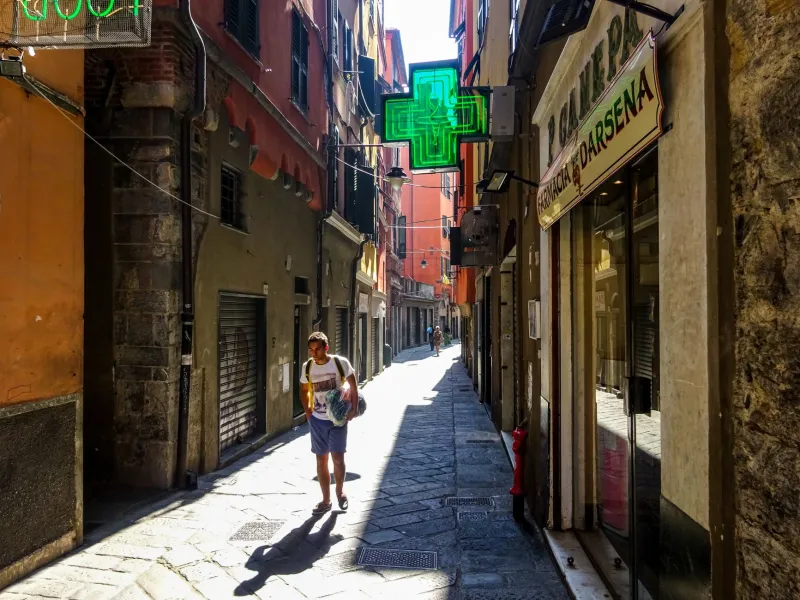
In Liguria, the pharmacy is easy to spot. Look for a green cross, often glowing, and the word farmacia. In larger towns you may find several. In a small village, there may be one, and it may keep old-fashioned hours. That is not a sign that nobody cares. It is a sign that the day has a shape.
Pharmacists in Italy are trained health professionals, and for minor problems they are often the first person you should ask. They can advise on colds, coughs, sore throats, mild stomach upset, allergies, sunburn, insect bites, minor cuts, and sprains. They can sell over-the-counter remedies, rehydration salts, topical creams, and basic first-aid supplies. They can also tell you, with admirable bluntness, whether your problem is a wait-and-see situation or a see-a-doctor situation.
What the pharmacist can actually do
Bring your passport or ID if you need to fill a prescription, and bring a list of any medications you take. US prescriptions do not automatically transfer. In Italy, many medicines that are prescription-only at home may be pharmacy-only here, and some familiar brands do not exist. The pharmacist can help you find an equivalent, but do not expect a perfect translation. Keep your medicines in their original packaging, especially if you take anything controlled or injectable. A doctor's note is not a bad idea.
If you need something for a fever, paracetamol is widely available under names like Tachipirina. Ibuprofen is also common. For a sprain, ask for advice on wrapping and whether you should be seen. For stomach trouble, rehydration salts are your friend. For a rash or bite, show the pharmacist the spot. They are used to tourists pointing at things.
English is common in tourist areas and less common in small villages. Speak slowly, use a translation app, or write down your symptoms. The pharmacist will meet you halfway. This is not the place for a dramatic monologue about your medical history. Keep it simple: what hurts, for how long, what you have already taken.
The rhythm of a Ligurian pharmacy day
Pharmacy hours vary by town and season, but many keep a split schedule: morning, a long lunch closure, and late afternoon. Sunday closures are common. In tourist areas, hours stretch. In small villages, assume the split until proven otherwise. If the pharmacy is closed, look for a sign on the door listing the farmacia di turno, the pharmacy on duty. This is the local rotation for nights, Sundays, and holidays. Ask at your hotel, your host, or the nearest bar if you cannot find the sign.
Do not wait until 8 p.m. with a worsening problem. If something feels urgent, call 112, the European emergency number, and ask for an ambulance. For non-emergency after-hours care, ask about the guardia medica or continuita assistenziale. In larger towns, you may find an English-speaking doctor. Your travel insurance may have a helpline; call it before you decide where to go.
When it is time for a doctor
A pharmacist can handle a lot, but not everything. Seek medical care for a high fever that will not come down, severe pain, a deep cut, a wound that is dirty or swelling, breathing trouble, chest pain, signs of dehydration, a rash that spreads quickly, or anything that feels beyond the ordinary. If you cannot bear weight on an ankle, if a wound needs stitches, or if you have a chronic condition that is flaring, do not let a language barrier talk you out of care. Ask the pharmacist where to go. Ask your host. Ask the person behind the bar. In a small town, everyone knows.
The unofficial prescription: rest, broth, and a slower day
Here is the part that may feel unfamiliar to a US traveler with a packed itinerary. The local remedy for a minor illness is often not a heroic push through. It is a slower day. Close the shutters against the afternoon sun. Drink water. Eat something simple. Broth, rice, bread, a little fruit. Sleep. Sit on a bench and let the day pass. If you are in a guesthouse, tell your host. They may bring tea, offer advice, or know which pharmacy is open. Accept it. This is not failure. It is how the bay takes care of people.
A note for US travelers
Before you leave home, check your insurance and save the emergency numbers. Carry a small card with your medication list and allergies. Pack a few basics: pain reliever, rehydration salts, blister plasters, any prescription you rely on. But leave room for the local version of care, too. The pharmacy is not a convenience store with a medical aisle. It is a small office of advice, and the advice often includes patience.
Getting sick on vacation is not the story you wanted. But it can be a story about a green cross down an alley, a pharmacist who draws a little map, a host who leaves a pot of broth, and a day that slows down enough to let you recover. In Liguria, help is rarely loud. It is usually just around the corner.