The Kitchen Faces the Water: Notes on a Room That Knows Where It Stands
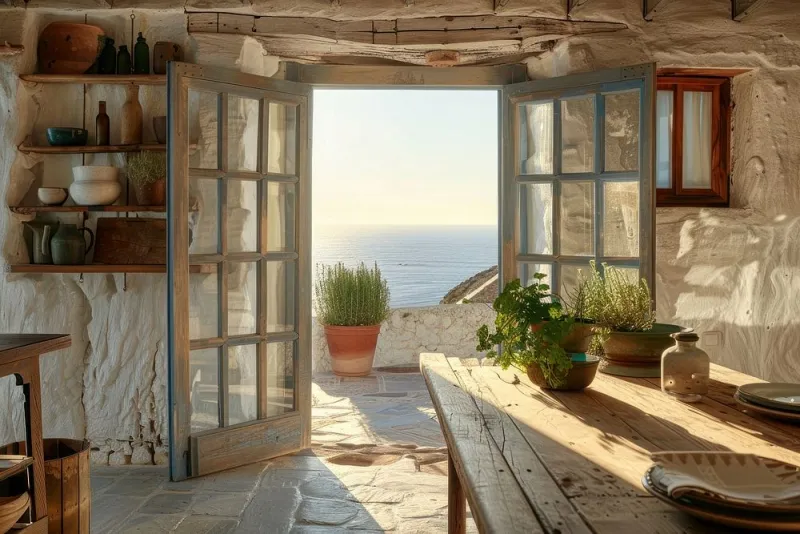
Photo: rustic Mediterranean kitchen window overlooking the sea with olive oil and salt on windowsill, via images.rawpixel.com
The First Thing You Notice Is the Angle
The first time I cooked in a Ligurian kitchen, I burned nothing. That's not a brag about my skills—it's because I kept stopping. The stove sat under a window, and the window framed the whole bay, and the bay was doing its late-afternoon thing, all copper and slow boats, and I stood there holding a wooden spoon like a tourist holding a passport.
My host, an older woman named Luciana who spoke to me in a mix of Italian and patient gestures, didn't understand why this was remarkable. "The kitchen faces the water," she said, shrugging. "Of course."
Of course. As if there were any other way to build a room.
Where the Salt Lives
Here's a detail I've since confirmed in a dozen homes around the bay: the salt keeps near the window. Not for any practical reason anyone can articulate. Some say it's tradition, some say it's luck, some say a kitchen without a view of the sea and salt within reach is a kitchen where you shouldn't eat the fish. The olive oil often sits there too, catching the light in its bottle like it's posing.
I've come to think of it as a kind of domestic choreography. The things you touch most—the salt, the oil, the coffee—gravitate toward the spot with the best light and the best sightline. The kitchen is arranged around a moment: the pause at the counter, the glance out the glass, the half-second where your hands stop and your eyes go somewhere vast.
Compare that to the American default, which is to arrange a kitchen around the refrigerator, or the island, or—God help us—the television mounted above the mantel in the open-concept great room. We optimize for flow and resale value. They optimize for the view from the cutting board.
Small Rooms, Long Views
Let's be honest about the real estate here. Ligurian kitchens are small. Sometimes comically small—the kind where you open the oven and have to step back into the hallway. The counter is a shelf. The dishwasher is a person, usually a grandmother, usually faster than your Bosch.
And yet nobody I met in the bay seemed to feel deprived. This took me a while to process, because I came from a culture where square footage is practically a unit of emotional wellbeing. We have entire cable networks dedicated to people gasping at walk-in pantries.
But watch someone cook in one of these kitchens and you understand the trade. They gave up counter space and kept the window. They gave up the island and kept the light. The room is oriented outward, toward the water, the way a church is oriented toward the altar. Everything in it knows what it's facing.
The Ritual of the Half-Window
Many of these kitchens have a second window set into the main one—a small wooden frame that swings open independently, so you can let the smell of frying anchovies out and the sound of the harbor in without losing all your heat. Luciana called it the finestrella. Little window.
She used it constantly. Talking to a neighbor across the alley? Finestrella. Checking whether the rain was done? Finestrella. It occurred to me that this tiny architectural feature was doing something our smart-home gadgets promise and never deliver: it connected her to the world outside without a screen, without an app, without a single notification. Just wood, hinges, and the smell of the sea coming in off the water.
What You Can Steal From This
I'm not going to pretend you can knock a window into your Chicago condo and suddenly have the Tyrrhenian Sea out there. Most of us are looking at a parking lot, an alley, or the neighbor's siding. Fine. The lesson isn't literally about water.
The lesson is about orientation. Pick the one thing worth looking at from your kitchen—maybe it's a tree, a strip of sky, the street where your kids ride bikes—and then arrange your life around it. Move the coffee setup to the spot with morning light. Put the table near the good window and actually eat there. Stop facing the television and start facing something alive.
A few small moves:
- Relocate the sink ritual. If you wash dishes by hand, do it at the window with the best view, even if it means a longer walk with a dripping pan.
- Give the salt a home. Keep one beautiful thing—oil, honey, a jar of anything—where the light hits it. Let it be useless and lovely.
- Open a finestrella of your own. Crack a window while you cook, whatever the weather. The smell of rain on the street is free entertainment.
- Sit down while things simmer. The sauce won't notice. The view might.
The Salt Stays by the Window
On my last morning at Luciana's, she made coffee while I packed, and I watched her do the whole thing without once turning her back to the sea. The salt sat where it always sat. The light came in low and gold. She poured two small cups, handed me one, and we stood at the counter looking out at the water like it owed us both money and had agreed to a payment plan.
I've been home for months now, and my kitchen still faces the wrong way—toward the wall, the cabinets, the fridge humming its one note. But I moved the salt. It's by the window now, next to the olive oil, catching what light there is.
It's a start.